2.1 ML Overview and Tabular Data
2.1.1 Machine Learning Overview
This section covers how data engineers prepare tabular data for machine learning workflows.
| Learning Type | How it Works | Task Types |
|---|---|---|
| Supervised | Models learn from features (inputs) and labels (outputs) | Classification (categorical labels), Regression (numerical labels) |
| Unsupervised | Models operate without labels - discover structure in data | Clustering, dimensionality reduction, anomaly detection |
2.1.2 Machine Learning Lifecycle
The ML lifecycle has four major stages:
| Stage | Activities |
|---|---|
| Scoping | Define project goals and success criteria |
| Data | Define data requirements, establish baselines, handle labeling and organization |
| Algorithm Development | Train/test split → train models → cross-validation → error analysis → iterate |
| Deployment | Write production software, monitor and maintain system performance |
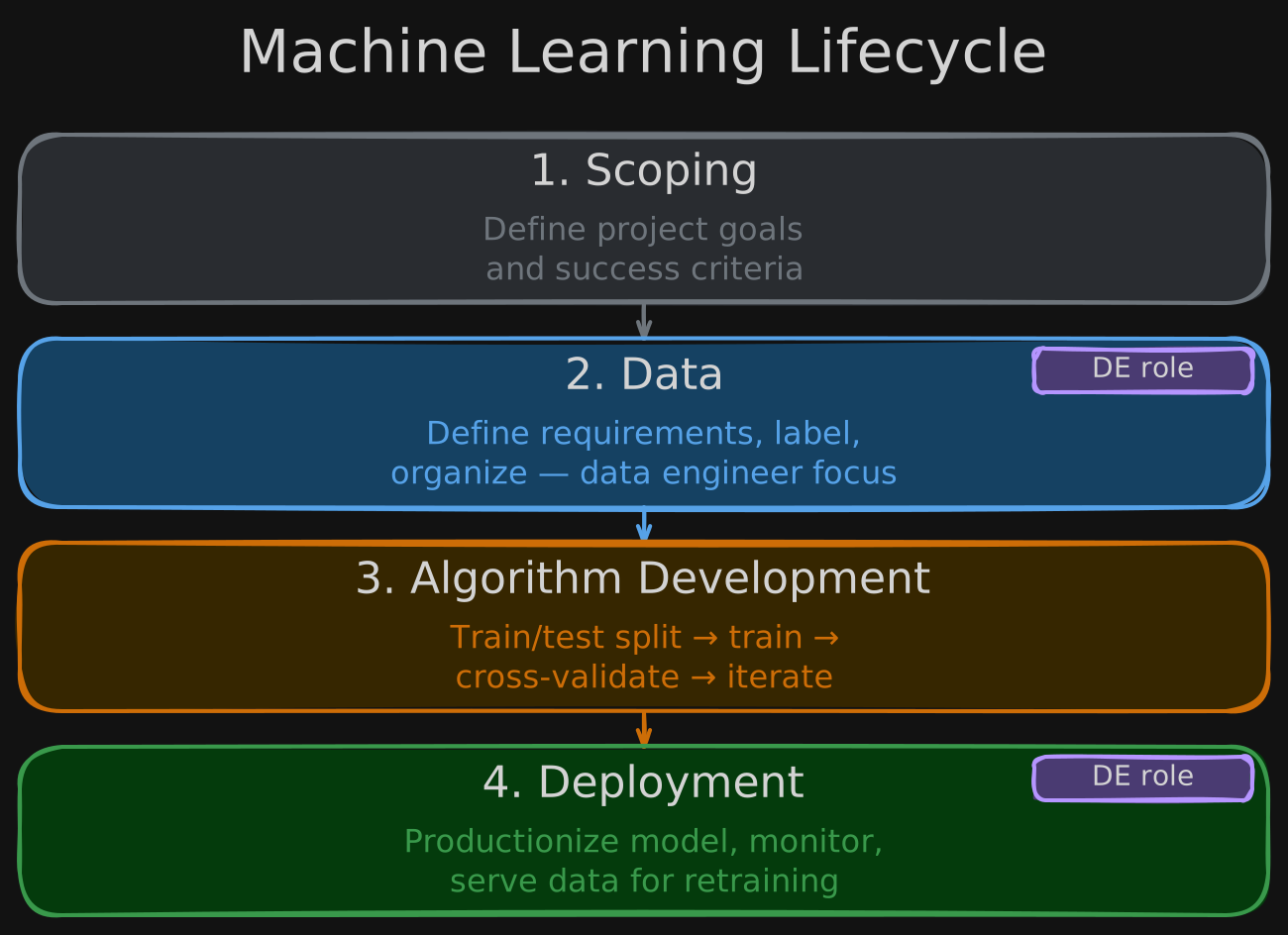
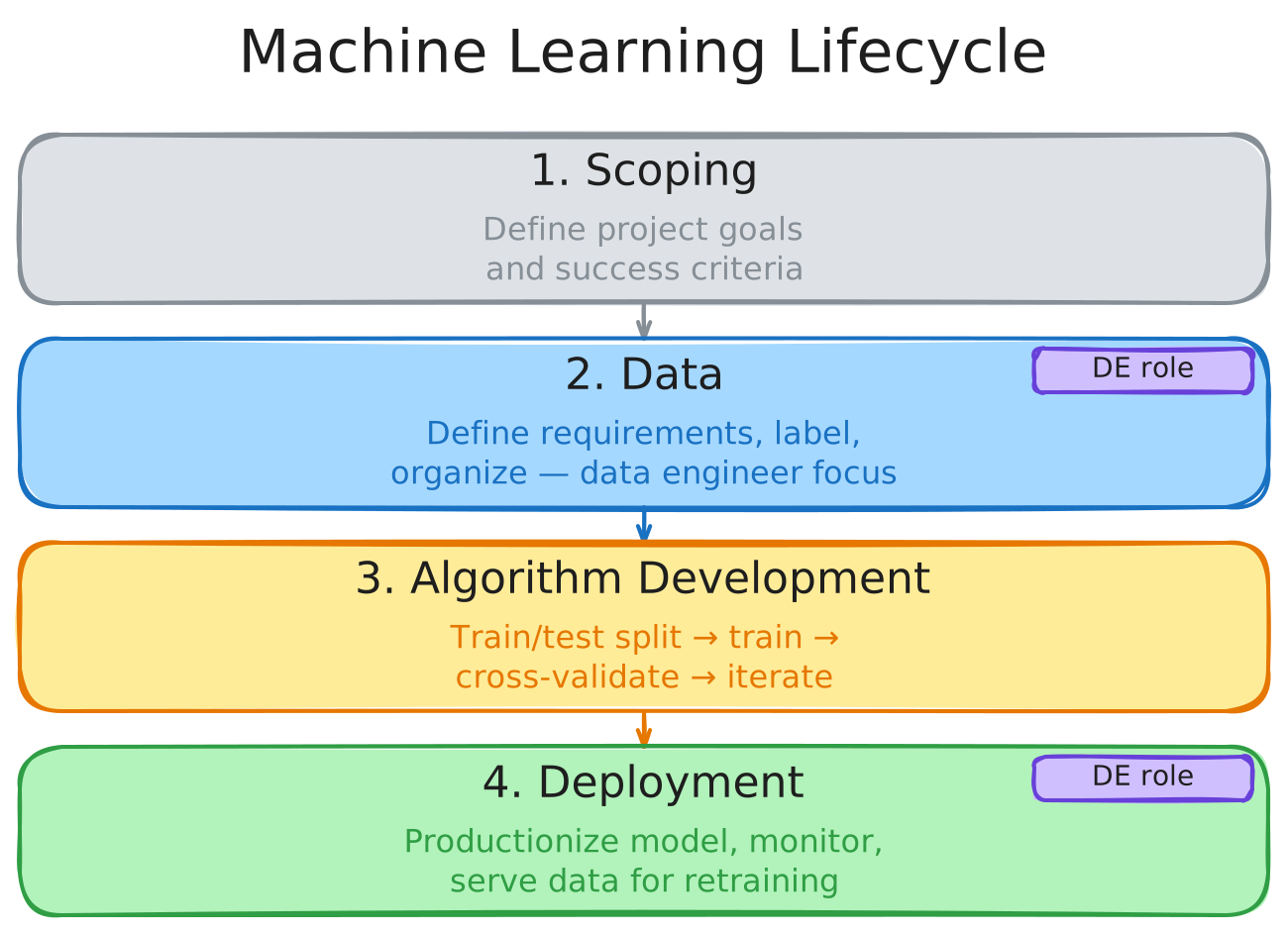
The Data Engineer’s Role in ML
Data engineers help organizations adopt a data-centric approach to ML - “garbage in, garbage out.” They collect high-quality data, prepare and serve data the model needs during deployment, and provide updated datasets for retraining.
2.1.3 Feature Engineering for Tabular Data
Feature engineering is any change or preprocessing applied to raw columns, or the creation of new features.
| Technique | Description |
|---|---|
| Handling missing values | Delete columns/rows if no valuable data is lost, or impute with mean, median, or similar-record values |
| Feature scaling | Required for gradient descent and distance-based algorithms |
| Encoding categoricals | Convert text categories to numbers for ML algorithms |
| Creating new columns | Combine or modify existing columns to create more predictive features |
Feature Scaling Methods
| Method | Formula | Result |
|---|---|---|
| Standardization | (x - mean) / std | Mean = 0, Std = 1 |
| Min-Max scaling | (x - min) / (max - min) | Range [0, 1] |
Encoding Categorical Columns
| Method | How it Works | Trade-off |
|---|---|---|
| One-hot encoding | Creates a binary column per category (0 or 1) | Increases dimensionality for high-cardinality columns |
| Ordinal encoding | Maps categories to ordered integers (e.g., basic=0, platinum=1) | Implies an ordering that may not exist |
| Hashing | Converts categories to hash values | Fixed output size, but collisions possible |
| Embeddings | Dense vector representations learned during training | Best for high-cardinality, requires neural network |
2.1.4 Scikit-Learn and Pandas for Processing Tabular Data

 Scikit-learn

 Pandas

 NumPy
NumPy
import pandas as pd

data = pd.read_csv("customer_churn_dataset.csv")

# Explore the data
print(data.shape)       # (rows, columns)
print(data.head())      # first 5 rows
print(data.describe())  # summary statistics

# Check for and drop missing values
print(data.isnull().sum())
data = data.dropna()

# Inspect categorical distributions
for col in ["Subscription Type", "Contract Length"]:
    print(data[col].value_counts(normalize=True))

# Separate features and labels
features = data.iloc[:, 0:-1]  # all columns except last
labels = data.iloc[:, -1]      # churn column (target)
Processing Pipeline
- Split data into training and test sets
- Standardize numerical columns (fit on train, transform both)
- One-hot encode categorical columns (fit on train, transform both)
- Combine processed columns and save to Parquet
from sklearn.model_selection import train_test_split
from sklearn.preprocessing import StandardScaler, OneHotEncoder

# Split into train/test sets
X_train, X_test, y_train, y_test = train_test_split(
    features, labels, test_size=0.2, random_state=42
)

# --- Standardize numerical columns ---
numerical_columns = [
    "Age", "Tenure", "Usage Frequency",
    "Payment Delay", "Total Spend", "Last Interaction"
]
scaler = StandardScaler()
scaler.fit(X_train[numerical_columns])  # learn stats from training set only

X_train_scaled = pd.DataFrame(
    scaler.transform(X_train[numerical_columns]),
    index=X_train.index,
    columns=numerical_columns
)

# --- One-hot encode categorical columns ---
categorical_columns = ["Subscription Type", "Contract Length"]
encoder = OneHotEncoder(sparse_output=False)
encoder.fit(X_train[categorical_columns])  # learn categories from training set only

X_train_encoded = pd.DataFrame(
    encoder.transform(X_train[categorical_columns]),
    index=X_train.index,
    columns=encoder.get_feature_names_out()
)

# --- Combine and save ---
X_train_final = pd.concat(
    [X_train["CustomerID"], X_train_scaled, X_train_encoded], axis=1
)
X_train_final.to_parquet("train.parquet")

# For the test set: use scaler.transform() and encoder.transform()
# Do NOT re-fit - statistics must come from the training set